
Call the owner can’t take
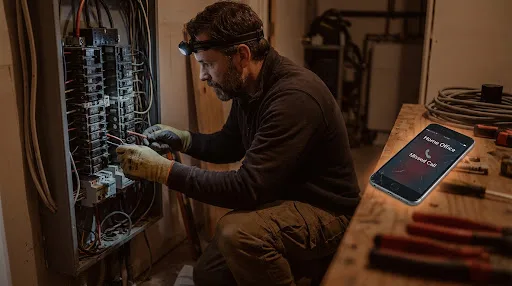
The tradesperson is on a job. Unanswered calls are forwarded to Max, only if the owner chooses to forward them.

Max & Mia are AI employees for UK tradespeople. Max answers the calls an owner can’t take; Mia turns each call into a reviewable callback job card. For us it is a production test of the hardest agent problem: letting AI talk to customers without letting it make commitments.
How it works
The tradesperson is on a job. Unanswered calls are forwarded to Max, only if the owner chooses to forward them.
A voice agent that speaks from the business’s approved details and gathers what the owner needs for a callback.
Structured extraction: the request in the caller’s words, area, timing, and the unknowns that still need checking.
Price, diagnosis, booking and attendance are decided by a person. The agent never commits on the owner’s behalf.
What it taught us
The most important behaviour is what the agent refuses to do. “Never promise a price or a booking” is enforced in design, prompts and evaluation, not left to model judgement.
Extraction that silently fills gaps is worse than no extraction. The job card separates reported facts from assumptions, and flags missing or contradictory details.
The agent speaks only from approved business context. The same principle applies to any enterprise assistant: constrain the source, then measure against it.
The agent prepares, a person decides. It is the pattern we recommend for regulated workflows too: propose, then approve.
We design voice and chat agents with grounded sources, hard boundaries and human approval built in.